
Situating Marco Paulo Rolla’s trajectory requires recognizing multidisciplinarity as a structuring principle of his artistic practice. Widely endorsed by him, the concept underpins an artistic approach free from rigid formatting, oriented toward the integration of knowledge and the stimulation of matter’s expressivity. Within this relationship, established over the past 40 years, he understands himself and is understood as an artist intrinsically linked to experimentation.
Prior to his formal path in the arts, Rolla moved across multiple languages: piano performances, scenic-vocal improvisations with the Estupefato company, Dadaist Super 8 film experiments, pastel drawings and cardboard assemblages shown in his earliest exhibitions. Upon entering the academic environment, he encountered these coexisting practices split apart by courses and disciplines under a regime of knowledge compartmentalization, since the very notion of “discipline” refers to an brazilian institutional model still marked by remnants of military lexicon. In contrast to this fragmentation, Rolla began to embrace, both in practice and in teaching, an “intelligent unconscious”¹ capable of articulating experiences and gestures within a continuous flow of research.
A defining example of how routine and creation intersect appears when Rolla, still a child, staged the act of having breakfast before his classmates. The gesture of “taking the cup, placing it on the table, and looking toward the next bite” remains in his memory, closely aligned with the logic of performance. Later, in 2001, this same sequence reemerged as the basis for the performance Breakfast. In it, the artist revisited movements naturalized by systems of order and pushed them into a spasm, dismantling the automatism of the scene.
Waking up, eating, working, earning money, sleeping and repeating such tasks synthesize the ordinary sequence of the capitalized individual. By suspending one of these actions, the artist introduces a “defect” into the mechanism and, in doing so, the strangeness of interruption transforms exhaustion into a moment of critical reflection. Here, John Cage’s paradox² applies: “I have nothing to say and I am saying it,” in which the apparent emptiness of action is precisely what renders its structure legible. Thus, in Marco Paulo Rolla’s work, visuality is inseparable from the formal and conceptual density of his practice.
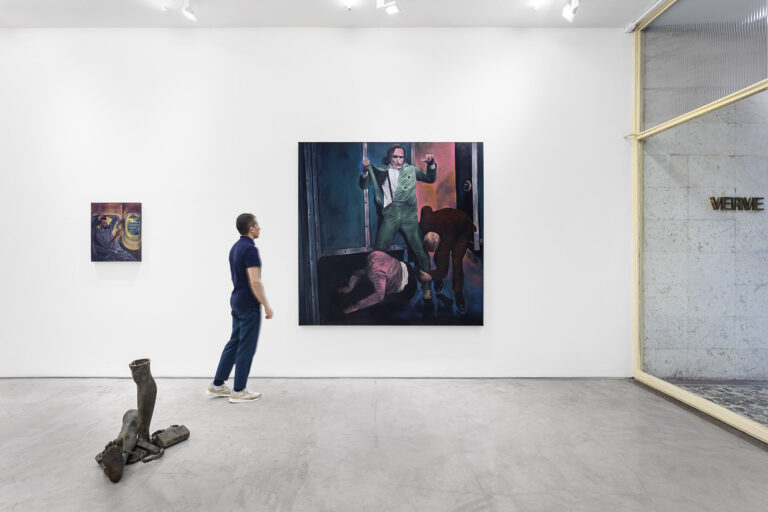
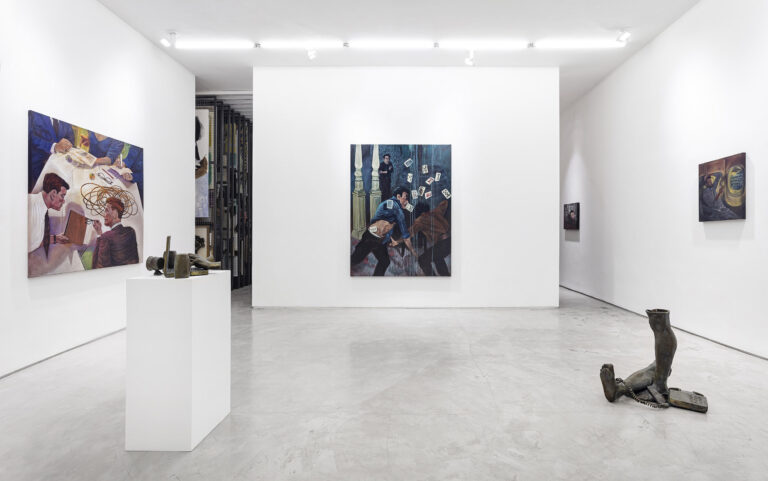
Understood as an equation, Rolla’s research brings together human fragility, dependence on norms, devices and habits, and the means used to materialize this friction. Although they take different forms, his works converge toward a corrosive effect: exposing the mechanisms of power behind banality. This effect is intensified in works produced between 2006 and 2025, in which the “calculated operations” of representing the work environment are exacerbated in paintings and sculptures, driven by the self-inflicted violence of maximized productivity³. Through the use of classical languages (painting and sculpture) Rolla finds a counterpoint to performance, revealing a disorder equally disseminated throughout the canonical history of art.
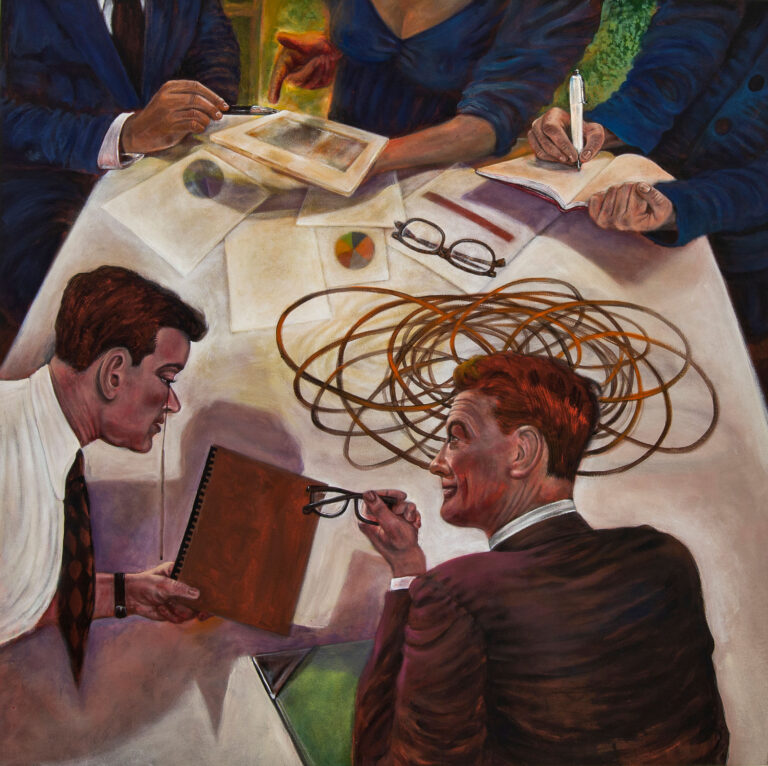
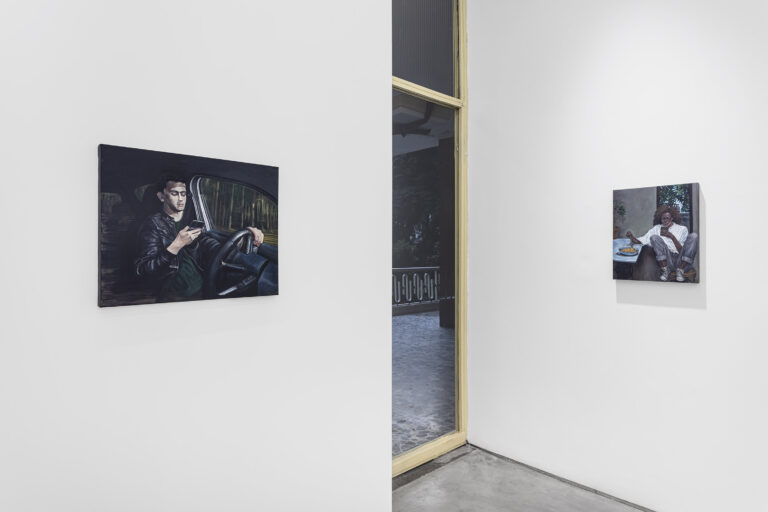
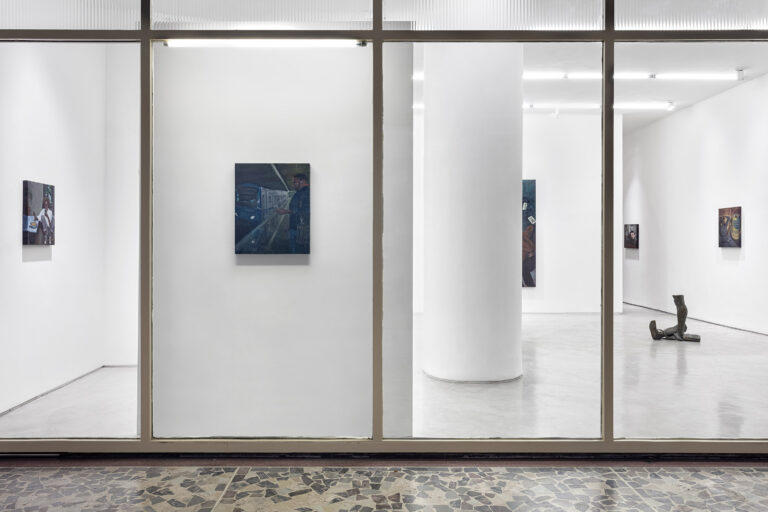
The way the artist’s works depict the transition from disciplined education to a performance-driven society is neither monotonous nor innocent. Notebooks, furniture and suits, present in large-scale paintings, derive a shared work environment rigidly defined by schedules of entry and exit, characteristic of the formation and domestication of the exemplary citizen. Smartphones, computers and televisions, along with informal clothing and urban contexts, appear in smaller paintings as indices of the same imperative – now flexibilized and dispersed – in which apparent contemporary freedom becomes a more subtle form of self-exploitation, and therefore more efficient and dominant than traditional mechanisms of control.
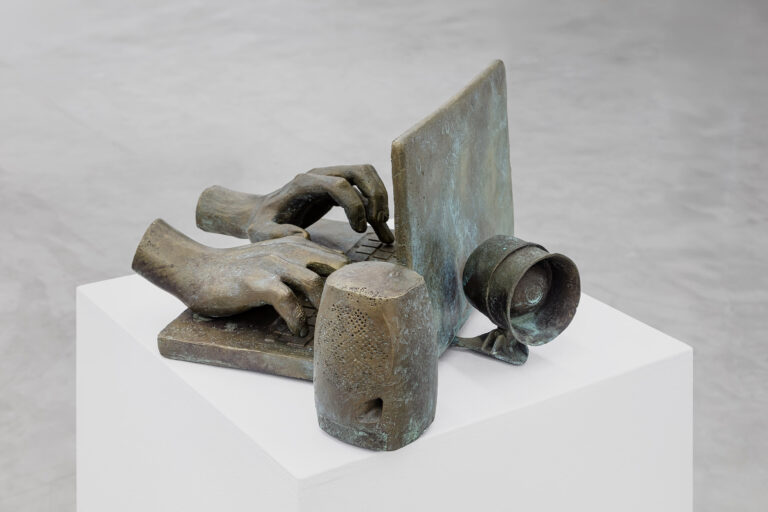
Bodies positioned in front of screens display an indifference that contrasts with the expressive intensity of collective labor. Under the logic of mobile workstations, enabled by digitalization, increasingly fragmented and isolated cubicles emerge. Social bonds are thus virtualized through mediating devices, narrowing channels of control. Utensils, machines and furniture no longer function merely as instruments serving the modern body, but as instances that extend it, shape it and, at times, render its contours undecidable. It is within this mutual implication between subject and object that the sculptures carry forward the announced disaster: the collapse of boundaries between body and instrument.
Returning to the “theater of emptiness,” highlighted by Raphael Fonseca when these works were exhibited in Belo Horizonte in the show Contrapoints and Countertimes, it is important to observe the effect of this regime of diminished attention. “There is no space in these narratives to look the viewer in the eye or at anything other than the glowing screens”⁴, seductive in their promises of postmodern totality. In this context, multidisciplinarity asserts itself with greater force, traversed by speed, the blurring of subject-object boundaries, and the dispersion of sensory stimuli, to the point of suggesting – however unstable – other forms of shared experience amid the weakening of social bonds.
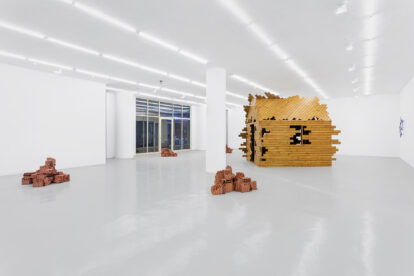
Resistant to any moralizing or conclusive discourse, the exhibition operates as an open reflection in which Statistics of Chaos condenses central procedures of Marco Paulo Rolla’s research and expands them in contact with the logic of labor and the passage from disciplinary education to a performance society, in its most calculated form.
NOTES
¹ ROLLA, Marco Paulo. “O artista ‘multindisciplinar’!”. Revista Estado da Arte, Uberlândia, v. 4, n. 2, jul./dez. 2023. DOI: 10.14393/EdA-v4-n2-2023-71541.
² CAGE, John. “Lecture on nothing”. In: CAGE, John. Silence: Lectures and Writings. Middletown: Wesleyan University Press, 1961, p. 109.
³ HAN, Byung-Chul. Sociedade do Cansaço. Tradução de Enio Paulo Giachini. Petrópolis: Vozes, 2015, p. 23.
⁴ FONSECA, Raphael; ROLLA, Marco Paulo. Contrapontos e Contratempos: Marco Paulo Rolla. Belo Horizonte: Minas Tênis Clube, 2025, p. 6.