
Judging by the landscape assembled by Daniel Acosta in the new room of Galeria Verve, like the other one also located in the mezzanine of the Louvre Building, things are not going well. Daniel, moving between art, design, and architecture, has always distilled a warm irony from the optimistic findings of these two latter disciplines and their determining utilitarian principles, employing materials such as the plastic flowers and shrubs that the Chinese have brought to an unprecedented level of finish, worthy of the attention of botanists in their classificatory pursuits, and formica, ah, formica, what a material! With its soft greens, pinks, blues, and yellows adorning the counters, tables, and chairs of restaurants and bars in the 1960s, making them akin to the pastel hues of the buildings in Miami’s Art Deco District, one of the vehicles for disseminating the American way of life as a permanent state of seaside vacation. Daniel and his immense pleasure in discovering sheets of formica that simulate wood and its grain. He seems to ask himself why on earth a laminate made of layers of paper and resin, subjected to high pressure, needs to disguise its artificiality.
Daniel Acosta frequents design and architecture, indifferent to what is and what is not functional. For those attuned to the thinking of the great and irascible Richard Serra, for whom the difference between art and architecture was that the former could not have a use, Daniel dares to insert hinges between these terms, tipping them back and forth. He produces houses that cannot be entered (he is an exceptional student of architecture, stations installed in inhospitable climates, such as bases in Antarctica), dry and blue pools of organic form, jets of water constructed as signs of jets of water, totemic constructions resembling planters filled with synthetic maidenhair ferns and other ferns. Daniel adds to the colors offered by the coatings industry the strident hues of neon lights. In addition to color, he explores ornament, another anathema of modernist purists: volutes, marquetry, patterns, and landscapes in fierce hues. All these elements compose his wall reliefs, benches, loveseats, shelves, and screens, the small spaces where people can sit, converse, or simply allow themselves to be carried away by constructive solutions composed of forms combined with one another, fitted together, articulated, arranged in divergent rhythms.
Daniel Acosta’s works have always exuded a certain optimism, a glimmer of hope in a world whose advance toward artifice is, to say the least, frightening. He carried on, leaving behind some joy, perhaps joy, like the cut-out wooden reliefs whose circular edges sprout colored circles – of formica. At least until now.
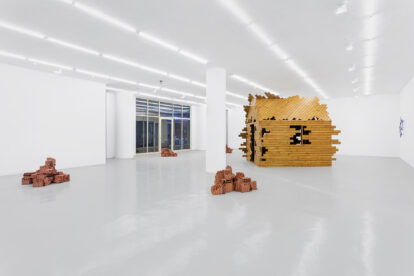
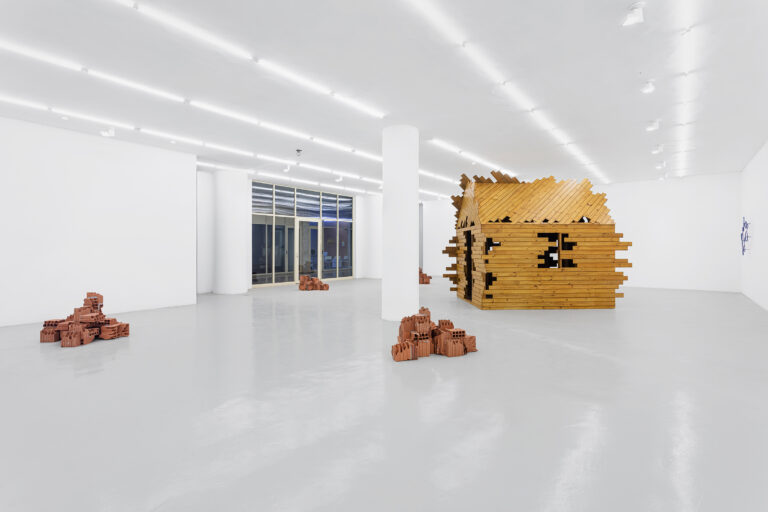
The front wall of the room reserved for Daniel Acosta’s exhibition is entirely made of glass, turning it into a diorama, those generally hyper-realistic three-dimensional representations of landscapes, human settlements, groups of animals, historical scenes, etc., common in Natural History museums. A house occupies the center of the landscape proposed by Daniel, an archetypal house, simple, made of wood, with a gabled roof and a façade reduced to a square topped by a triangle.
Scattered around the house, some stones, boulders, ruined blocks? On the side walls and the back wall, forms composed of smaller and larger circles painted blue. Clouds?
Daniel Acosta is a proponent of enigmas. Much of what he does suggests that it is something else, eventually many other things. This time is no different. Walking among the stones, one sees that they are rough, ordinary hollow blocks that were once part of some construction, as can be inferred from the presence of cement holding fragments of block together. Were they destroyed by the action of the sea advancing over the beach, as happens on Cassino Beach, a few kilometers from Porto Alegre, where the artist lives? Are they remnants of the action of rivers, animated by devastating floods and currents, or perhaps the remains of something brought down with sledgehammers?
The blue “clouds” on the walls are made of the same material as the bars with which we enclose our houses and seal off our windows. There was a time when windows and doors were the membranes through which we entered and returned from exterior space. Today, in designing them in response to our chronic insecurity, we lend them ornamental attributes, a strategy for softening our instinct for defense, our aggressive instinct for defense, increasingly and ever more intensely provoked.
The walk around the house, inevitably having it as the center of the scene, makes its incongruous behavior fully apparent. The archetypal house, one of the seeds of all houses, is coming apart. The wooden beams that make up its walls and roof extend beyond the limits of their edges in a counterclockwise direction, under the effect of a swirling vortex, like the wind south of Cassino Beach—“the longest beach in the world,” as its residents proudly declare—already close to Uruguay, where it is difficult to live, because the wind destroys everything, like the water that has been devastating southern Brazil, protagonist in the collapse of the Brumadinho dam, of the flood that this week submerged in mud the cities located below Nepal.
A few words about this house that reminds us of the mythical and unique house that Le Corbusier built for himself in 1951. Known as the Cabanon, made of wooden logs, it was built by the architect for use during his holidays, as was the case over the course of 14 years. Cabanon is the French diminutive of cabin, which gives the measure of the about-face of this man responsible for the idea of the house as a machine for living in, for reinforcing the architecture-urbanism binomial, an ardent defender of skyscrapers and exposed concrete. He conceived for himself a house resembling the shelters of French shepherds, a primeval dwelling, reduced to the strict essentials, retreating to the origins of architecture.
Daniel Acosta is full of subtleties: the house in this exhibition recalls that Le Corbusier’s Cabanon has a powerful precedent: the house that Henry David Thoreau, the North American polymath revered by anarchists, by Leo Tolstoy and Mahatma Gandhi, author of the celebrated manifesto in favor of civil disobedience (1849), built when he decided to venture into the woods, toward purity – simplicity, simplicity, simplicity! – to escape urban life and technological progress, settling on the shores of Walden Pond, in the state of Massachusetts, USA. And if Le Corbusier’s Cabanon emulates the house reduced to space and the sparse, elementary furnishings of Thoreau, another house follows in this direction, much closer to us: the house that Theodore John Kaczynski built to live in in 1971, in the municipality of Lincoln, in the state of Montana, USA, identical in form to Thoreau’s, although somewhat smaller, without electricity or running water. Kaczynski, a brilliant mathematician, I.Q. 167, an anarchist, a defender of nature like Thoreau, distraught by the destruction of the forest around him and the proliferation of real-estate and industrial projects, became the famous terrorist known as the Unabomber, sending letters that exploded, responsible for the deaths of 3 people and the injury of 23 others. He operated for 18 years, from 1978 to 1996, hunted unsuccessfully by the FBI, even when he decided he would stop the attacks provided that the New York Times and The Washington Post published a 35,000-word manifesto, Industrial Society and Its Future. The newspapers took 3 months to decide whether to publish it, eventually capitulated, and that was what gave the criminal away: his brother David recognized his style and arguments and turned him in.
The Unabomber’s house is preserved in an FBI storage facility and is not open to visitors, but a paper replica of it can be purchased online, according to an advertisement that recommends it as Perfect for decorating your home!
Daniel Acosta’s house is a reduced version of the houses of Thoreau and Kaczynski. His discovery, let us agree, is extraordinary, although it is not known what it means. Who will know? What we do know is that the three of them, Le Corbusier deserves to be included, sought a refuge in nature, as discreet and insignificant as possible. Thoreau did not live to see his space, almost as little space as his body required, besieged by the civilization whose course he foresaw as intolerable. Le Corbusier, herald of that same civilization, needed to withdraw periodically. Kaczynski disseminated his message with murderous tentacles.
Daniel Acosta reflects on this coincidence by presenting a landscape made of the remnants of objects and signs, a landscape composed of wood, stone, and metal, disintegrating from a refuge reduced to the bare minimum, under the impact of an irresistible centrifugal force.